Extreme Ultrafast Optics
What can we gain by pushing ultrafast light to its absolute limits?

Success message
Error message
What can we gain by pushing ultrafast light to its absolute limits?
Ultrashort pulses are exceptionally brief bursts of light, with durations ranging from picoseconds to femtoseconds (a femtosecond is 10^−15 seconds, or one millionth of one billionth of a second). Their significance lies in several key properties: their extremely high peak power, their capacity to encode substantial amounts of data, and their duration, which is shorter than many fundamental physical processes. These characteristics allow ultrashort pulses to provide profound insights into the fundamental workings of materials and molecules.

When ultrafast light is confined to a small volume within specialized materials, it interacts with its environment with exceptional efficiency and strength. My research explores how these ultra-efficient or ultra-strong interactions lead to novel phenomena that could be harnessed for future technological applications.
For more information, please refer to our recent work below or the Publications section or feel free to contact me directly.
We theoretically studied how light can be confined to edges of a crystal that changes extremely rapidly in time. Phys. Rev. Lett. 135, 163801, (2025)
We theoretically studied how an abrupt change of material properties causes light to scatter when its above the critical refraction angle. L. Bar Hillel, et al, PRL (2024)
We wrote a review article on "photonic time crystals" which are the analogue of "photonic crystals" but in time. E. Lustig, et al, Optics Express (2023).
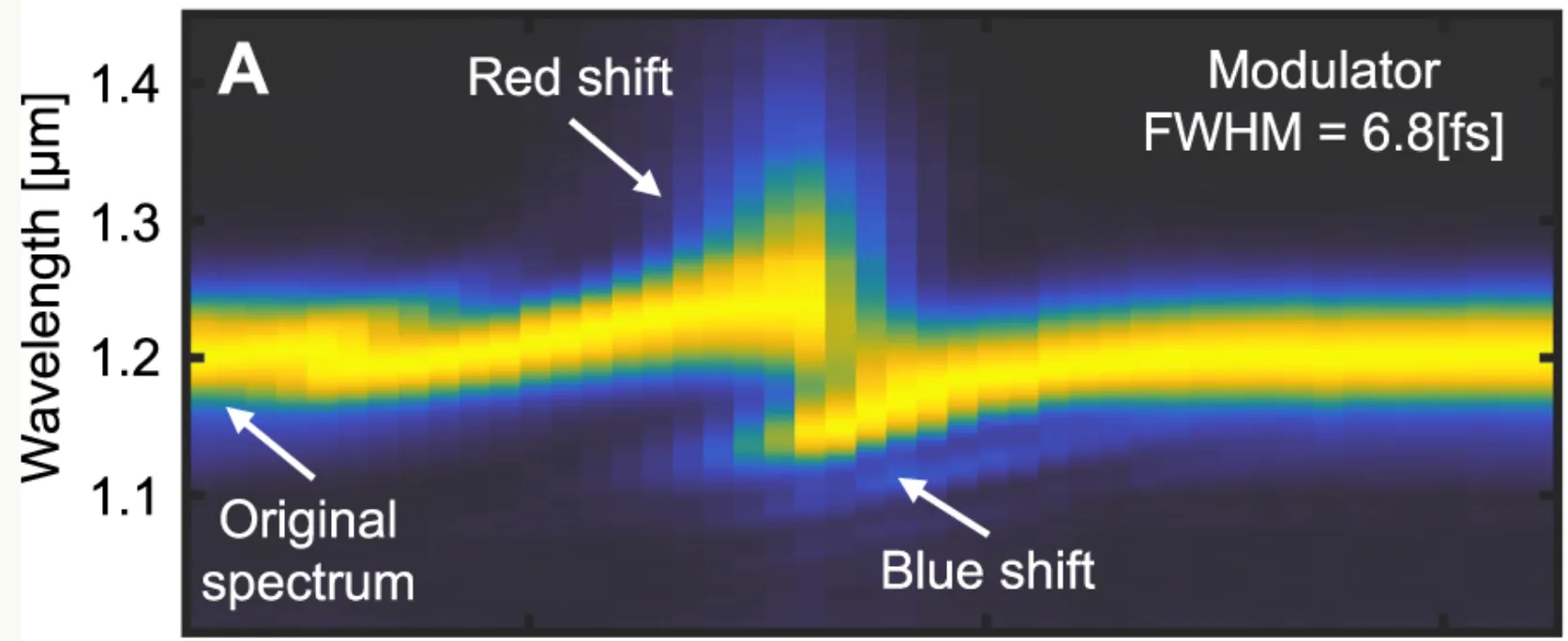
We demonstrated how light "time-refracts" when a material changes it's transparency abruptly E. Lustig*, O. Segal*, et al, Nanophotonics, (2023). In the Press